Depth First, Then Yardage: the Pennsylvania Mulch Calculator
Enter your project dimensions
A bed that came through a wet Pennsylvania winter is not the same job as a bed cut fresh out of lawn, and the two want different depths. So the depth goes in first, before any measuring, because it is the number people guess at and the one that decides how much arrives.
| The bed in front of you | Depth to enter | Why that figure |
|---|---|---|
| Last year's beds, crust raked loose | 2 in | Tops the existing layer back up without burying crowns |
| Bare soil in a newly cut bed | 3 in | Enough to shade out weed seed and hold moisture into July |
| Tree ring, kept flat and pulled back off the trunk | 3 in | Same as a new bed, but stopped 3 to 6 in short of the bark |
| Bed on a noticeable grade | 2 in | A deeper layer floats and travels in a heavy summer storm |
| Anywhere near the foundation | 2 to 3 in | Kept thin, below the slab line and off the siding |
| Playground surfacing, certified chip | 6 in | A different material from landscape shred, checked against the equipment manual |
Four inches is the ceiling for any bed. A deep wet layer shuts air out of the root zone, and a Pennsylvania spring supplies plenty of wet.
The ground under the bed, and the week it is ready to work
Pennsylvania is not one growing ground, and what sits under a bed changes the depth that suits it and the week it can be worked.
- Limestone valleys through central and southeastern Pennsylvania weather to a heavy clay that holds spring rain. Beds over it stay wet long after the surface looks dry, so the 2-inch line in the table is the safer entry there.
- Shale and sandstone plateaus across the west and north carry thinner, faster-draining soil. Those beds give water up between storms, which is where the full 3 inches on bare ground earns its keep.
- Stony glacial ground in the northeast and northwest corners, and up in the Poconos, works weeks later than the southeast. Mulch spread on soil that is still cold and sodden keeps it that way.
- Southeastern Piedmont uplands, loam over schist and gneiss, drain well and warm first, so those beds are usually the first in the state to take a load.
Measuring beds that wrap a corner and rings that are not beds
Rectangle takes length and width in feet. Circle takes the diameter in feet, measured straight across the widest point. Multiple areas is the one that earns its keep here: it holds up to five pieces and totals them, so a foundation strip, a corner bed and three tree rings can go in as one calculation instead of five.
A bed that curves is two or three rectangles for this purpose. Getting within a foot on a bed edge is close enough for mulch, which is not something you can say about a paver base.
Depth goes in as inches, and the box accepts anything from 0.25 to 24. Choose the material, leave on or untick the optional five percent for compaction and spillage, then press calculate. Cubic yards, tons and cubic feet all come back, and Email my quote will send the figure over.
Three spring jobs, worked out in yards and bags
There are 27 cubic feet in a cubic yard, which is exactly 13.5 garden-center bags at 2 cubic feet each. That conversion is what makes a bag count useful next to a yardage.
Examples only, hypothetical measurements.
| Job | Working | Cubic yards | Bags at 2 cu ft |
|---|---|---|---|
| Foundation strip, 58 ft x 3 ft at 3 in | 174 sq ft x 0.25 = 43.5 cu ft, ÷ 27 | 1.61 yd³ | 22 |
| Three tree rings, 7 ft across each, at 3 in | 3 x 38.5 = 115.5 sq ft x 0.25 = 28.9 cu ft, ÷ 27 | 1.07 yd³ | 14 |
| Refreshing 640 sq ft of established beds at 2 in | 640 x 0.1667 = 106.7 cu ft, ÷ 27 | 3.95 yd³ | 53 |
The depth box takes one figure for a whole run, so the strip and the rings go through together at 3 inches and the refresh goes through on its own at 2. Added up, the three come to 6.63 cubic yards, or about 90 bags. That is the point at which the bag count stops being a shopping plan and becomes an argument for bulk.
The problem this solves. Beds get topped up every spring and the level creeps. The cause is adding a full three inches over a layer that never broke down, year on year, until the crowns of the perennials are buried and water cannot get down to them. The fix is to rake the crust loose, measure what is actually there, and enter 2 inches instead of 3 when last year's layer is still holding.
Six hundred pounds a yard, which is why tons is the wrong box to read
Shredded hardwood runs about 600 lb per cubic yard, roughly 0.30 tons. That is the published figure and it is approximate. Compare it with the same cube filled with screened topsoil at about 2,200 lb, or with clean crushed stone at about 2,800 lb, and it is clear why mulch is sold and delivered by volume.
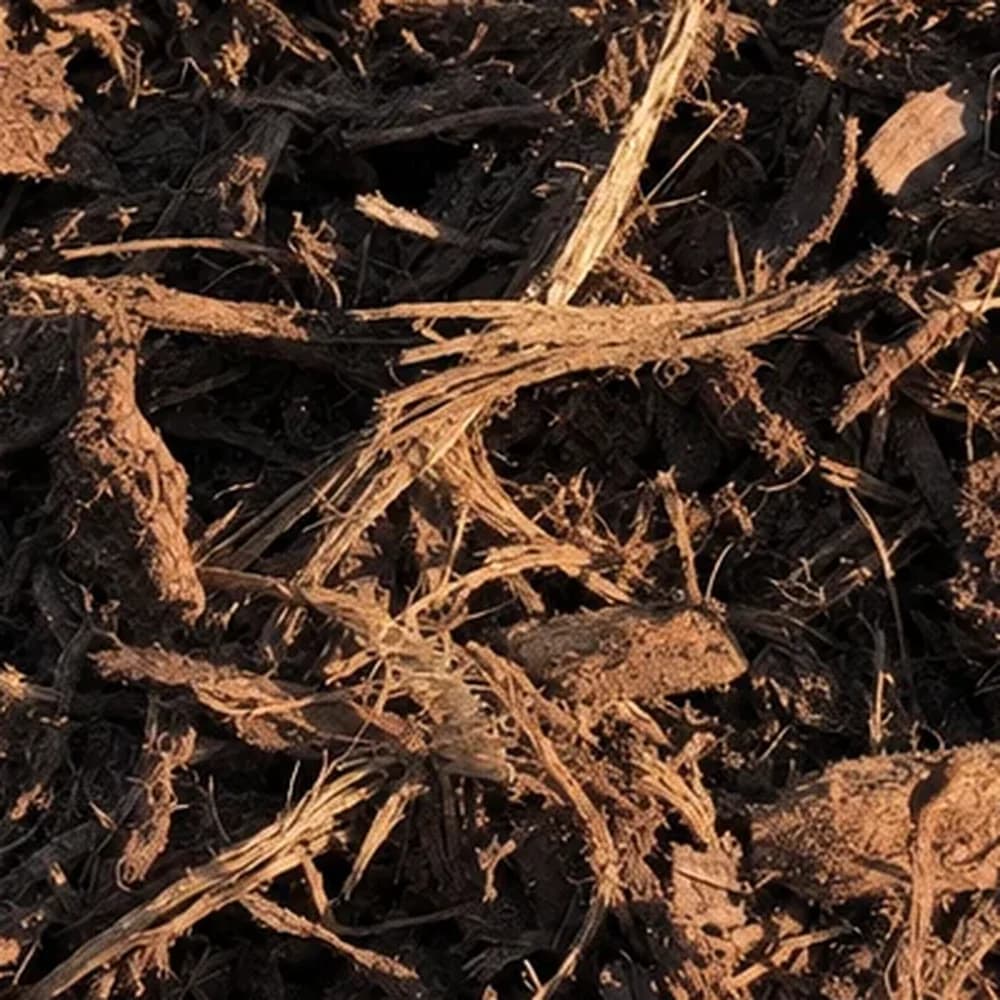
On this page, read the cubic yards. The tons figure is correct arithmetic and nearly useless for ordering, because three and a half yards of mulch weighs about a ton and a truck runs out of room long before it runs out of weight. Type does not change the calculation either. Chips, nuggets, dyed and shredded all occupy the same space per yard, so they differ in how they look and how often they need doing again, not in how much you order. This calculator is set for Shredded Mulch, which knits together and holds its place on a mild slope better than loose nuggets.
Ordering a little over, and what to do with the extra
Round up rather than down. A half yard left over goes on the strip behind the garage that nobody measured, and a half yard short means the last bed stays bare until someone makes a second trip. The five percent tick box is there for spillage, and on mulch it is a small number on a small tonnage, so the practical allowance is your rounding.
Spread what arrives within a couple of weeks. A pile left standing for a month heats in the middle and turns sour. Put the load on a tarp if it is going on a drive, keep it clear of the wires and the septic lid, and give the truck a firm, open spot to tip. Late April through May is the usual window in this state, once the ground has drained enough to get a wheelbarrow across the lawn without rutting it.
If the bed is being built rather than topped up, the layer underneath is its own order: Garden Soil sized on the soil calculator, or the topsoil calculator where the grade has to come up. Mulch goes over the finished surface.
Take the yardage to the Shredded Mulch product page, set the quantity and a date, and delivery is arranged at checkout from your ZIP code. If your beds are a shape that will not break into five pieces, send the measurements through the contact page.
Common questions
How do I work out a round bed or a ring around a tree?
Use the circle shape and give it the diameter, measured straight across, not the distance from the trunk out. A 6 ft ring at 3 inches is 3.1416 x 3 x 3 = 28.3 sq ft, then 28.3 x 0.25 = 7.1 cu ft, which is 0.26 cubic yards or about 4 bags. Several rings go in as separate areas and the tool totals them.
Can I check the figure on paper?
Multiply the bed length by its width for square feet. Divide the depth in inches by 12 and multiply through, which gives cubic feet. Divide by 27 for cubic yards. Multiply the yards by 13.5 if you want the equivalent count of 2 cubic foot bags, or by 9 for 3 cubic foot bags.
Why does a yard of mulch weigh so much less than a yard of stone?
Because the tool applies each material's own published weight after it works out the volume. Shredded hardwood is about 600 lb per yard against roughly 2,800 lb for clean crushed stone, so an identical bed comes back at a fraction of the tonnage in mulch. The cubic yards are the figure to compare when you are weighing up two materials for the same space.
Should I tick the five percent box for mulch?
It does no harm and it is honest about what gets lost to the wheelbarrow and the wind. It is not where your real margin comes from. On mulch the useful cushion is rounding the yardage up to the next half yard, because bed edges measured by eye are worth more than five percent either way.
My beds are cut into a bank. Does the depth change?
Keep it at 2 inches rather than 3 on anything with a noticeable fall, and measure the bed along the ground rather than on the level, since that is the surface being covered. A thick layer on a slope is what ends up on the walkway after a heavy summer storm. Shredded mulch holds a grade better than nuggets do, and a low edge board at the bottom of the run holds the rest.
Related calculators
Skip the 27-bag cart.
Bulk shredded hardwood by the yard, tipped in your driveway, delivery free.