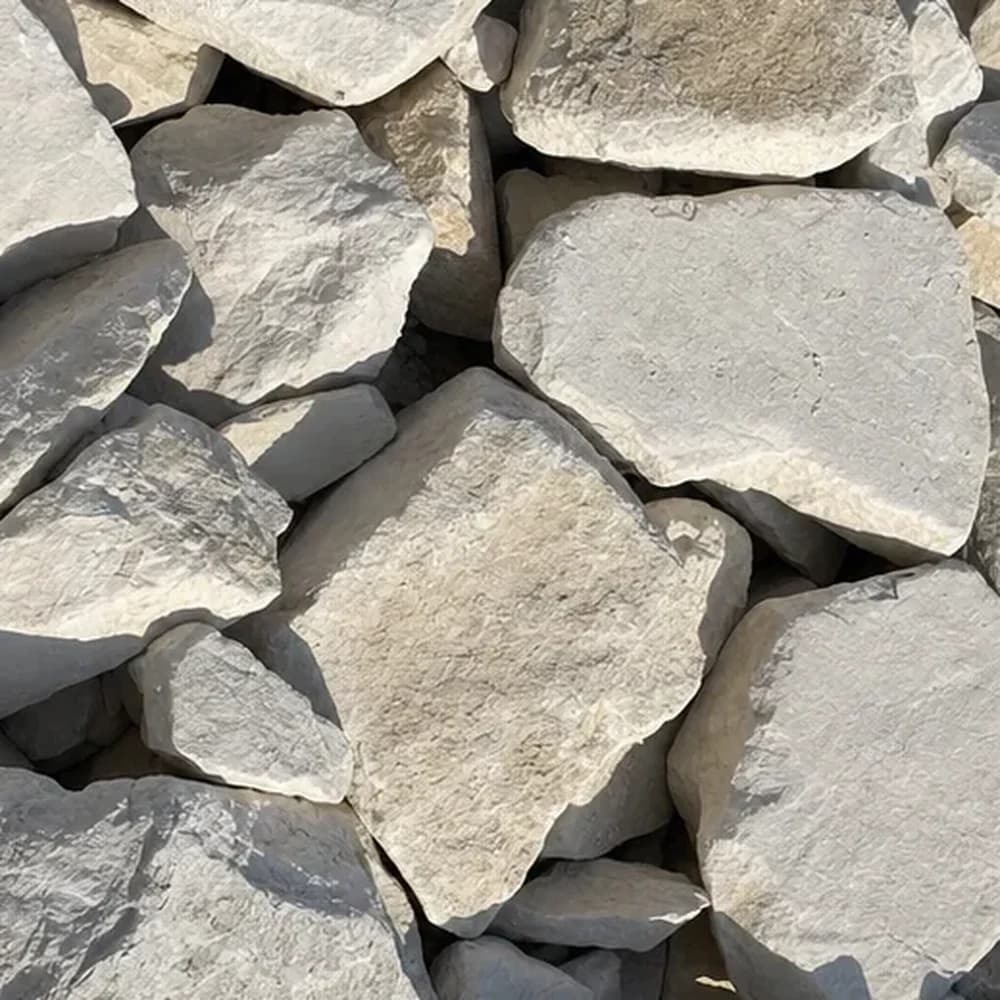
Rip Rap Calculator for Ditches, Outlets and Stream Banks
Enter your project dimensions
Two jobs, both visible from where you are standing after a hard thaw. A culvert outlet that has cut a hole downstream of the pipe: about 5.5 tons. Forty-five feet of stream bank that has lost its face and is taking the field with it: about 31 tons. The washout looks like the bigger problem and the bank costs nearly six times the stone, because armor work is priced by slope-face area multiplied by a layer thickness measured in feet, not by how bad the damage looks.
| Hypothetical job | Area measured | Layer depth | Tons at 1.55 |
|---|---|---|---|
| Culvert outlet apron, 12 ft x 8 ft | 96 sq ft of ground | 12 in | 5.5 |
| Stream bank, 45 ft long with an 8 ft slope face | 360 sq ft of face | 18 in | 31.0 |
Apron: 96 x (12 ÷ 12) = 96 cu ft, then 96 ÷ 27 = 3.56 yd³, and 3.56 x 1.55 = 5.5 tons.
Bank: 360 x 1.5 = 540 cu ft, then 540 ÷ 27 = 20.00 yd³, and 20.00 x 1.55 = 31.0 tons.
Running the tape down the bank face, not across the map
This is the measurement that decides whether the order is right. Put the tape on the slope itself, from the top of the bank down to the toe below the waterline, and multiply that by the length of channel or shoreline you are armoring. A 45 foot run of bank with an 8 foot face is 360 square feet of stone to cover, even though on a plan it occupies far less ground.
Then set the layer depth. The minimum for erosion control is 12 inches, and the rule that governs it is 1.5 to 2 times the largest stone dimension. Residential stone in the 4 to 12 inch range generally needs 12 to 18 inches. The depth box on this rip rap calculator runs from 0.25 to 24 inches, and 24 is a real ceiling here rather than a theoretical one: a layer thicker than two feet is a job to size in two passes, and the stone that needs it usually belongs on an engineered drawing.
Shapes are rectangle, circle, or multiple areas, which holds up to five pieces and totals them. Feet for length, width and diameter, inches for depth. Select the material, tick the optional five percent for compaction and spillage, press calculate, and the answer comes back in cubic yards, tons and cubic feet at once. Email my quote sends it over.
Why one ton of armor stone covers seventeen square feet
Rip rap is published here at about 3,100 lb per cubic yard, or 1.55 tons per yard, and it is approximate. That makes it the heaviest material in the catalogue, but weight is not what limits the coverage. Depth is.
| Layer depth | 1 ton covers | Tons per 100 sq ft |
|---|---|---|
| 12 inches | ≈ 17 sq ft | 5.7 |
| 18 inches | ≈ 12 sq ft | 8.6 |
| 24 inches | ≈ 9 sq ft | 11.5 |
A ton of decorative stone spread two inches deep covers well over a hundred square feet. The same ton at a 12 inch armor layer covers a square about four feet on a side. That is why the pile always looks too small on the day it lands and then runs out halfway up the bank. Cubic yards is the size of the heap, tons is the unit it is weighed and sold in, and cubic feet is worth reading only to sanity-check the depth you typed.
Ordering long rather than short on a bank you have to open twice
The five percent tick box is a modest allowance and armor stone does not nest predictably, so treat it as the floor. Round up, and keep a small reserve on site.
The reason is what happens underneath. The toe has to be buried below the waterline or the expected scour depth, because failure starts at the bottom and works up. Run short and the temptation is to thin the toe course to reach the top of the bank, which is exactly backwards. There is a bedding order to allow for as well: non-woven geotextile under the stone, which a landscape supplier carries and this site does not, or 3 to 4 inches of #4 Crushed Stone, sized on the stone calculator. On the 360 square foot bank above, a 4 inch bedding layer is 120 cubic feet, 4.44 cubic yards, about 6.4 tons at 1.45 tons per yard.
Before that toe course goes in below the ordinary high water line of a stream, pond or lake, find out what approval your state and local authorities require. Work in and along a watercourse is commonly permitted work, and what is asked for follows the waterbody.
Check the route in before you order. The last stretch of track to a pond or a creek bottom is soft ground in this state for a good part of the year, and stone tipped short of the work has to be moved a second time by hand. Slopes want to be at 2:1 or flatter before stone goes on. Steeper than that is an engineering question, not a stone quantity question.
R-4 for the ditch, R-5 and up for the bank
Pennsylvania yards sell armor stone by R-number, and matching the number to the water is the material decision this page turns on.
- R-4 is the ditch and swale size: roadside channels, driveway ditches, culvert outlet aprons, slow water.
- R-5 to R-7 are the bank sizes: stream banks, pond edges exposed to wake, and anywhere flow gets fast after snowmelt.
Neither of the two heavy stones people set against this one is armor: Large River Rock is rounded and decorative, and Railroad Ballast is clean angular stone for hard standing rather than for a face under moving water.
When you are between two sizes, take the larger stone and increase the layer depth with it, because the extra weight is what buys tolerance. Carry an outlet apron 4 to 6 pipe diameters downstream, since the scour below a culvert is the hardest working water on most properties. Bigger pieces need a machine: rock up to about 6 to 8 inches can be placed by hand, and above that it is a machine job. Place the top course so the pieces lock against each other rather than landing where they fall.
Sized and ready, take the tonnage to the RipRap product page, set the quantity and the date, and delivery is arranged at checkout from your ZIP code with a firm spot for the truck to tip. For a slope you cannot safely measure, send what you have through the contact page.
Common questions
The bank is curved and the face gets deeper towards the creek. How do I measure that?
Break it into two or three straight lengths and enter them as separate areas. Take a face measurement at the middle of each length rather than at its ends, and treat the curve as chords, which overestimates slightly and on armor stone that is the right way to be wrong. Up to five pieces can be totaled in a single calculation.
Part of the bank is already stoned and only needs topping up. What do I enter?
Measure only the area that is actually thin or bare, and enter the depth you need to add rather than the full layer thickness. Probe down through the existing stone in a few places with a bar first, because a patch that looks shallow is often sound stone with a scoured pocket at one end. If the fabric or the soil is showing anywhere, that section is a rebuild, not a top-up, and gets the full layer.
What happens if I order less than the calculation says?
The layer ends up thinner than it needs to be somewhere, and on a bank that somewhere is usually the toe, which is where scour starts. A 12 inch design laid at 8 inches over part of its length is not eighty percent as good, it is a weak point the water will find first. Order the calculated figure, round up, and if a run has to be split across two orders, finish the toe fully rather than spreading everything thin.
How close is this estimate to what the bank will actually take?
The arithmetic is exact and the ground is not. Armor stone is graded and irregular, so it nests differently from one load to the next, and a slope face measured with a tape on uneven ground is a good approximation rather than a survey. Treat the result as a working figure, add the five percent, and round up. Bedding stone and fabric are separate quantities and are not included in the tonnage the tool returns.
Which product page do I open once I have the number?
RipRap for the armor stone itself, and #4 Crushed Stone if you are bedding on stone instead of fabric. Those are two separate lines on the order and two separate runs of the calculator, since they sit at different weights, 1.55 and 1.45 tons per cubic yard. Tell the yard the R-number you want when you place it.
Related calculators
Banks don't armor themselves.
RipRap by the ton with free delivery, plus the #4 bedding stone to go under it.